

ArcX TacSense - Defence DASA Grant Proposal
DASA grant proposal for a rugged tactical smartwatch with GPS, biometrics, and non-invasive hydration sensing.
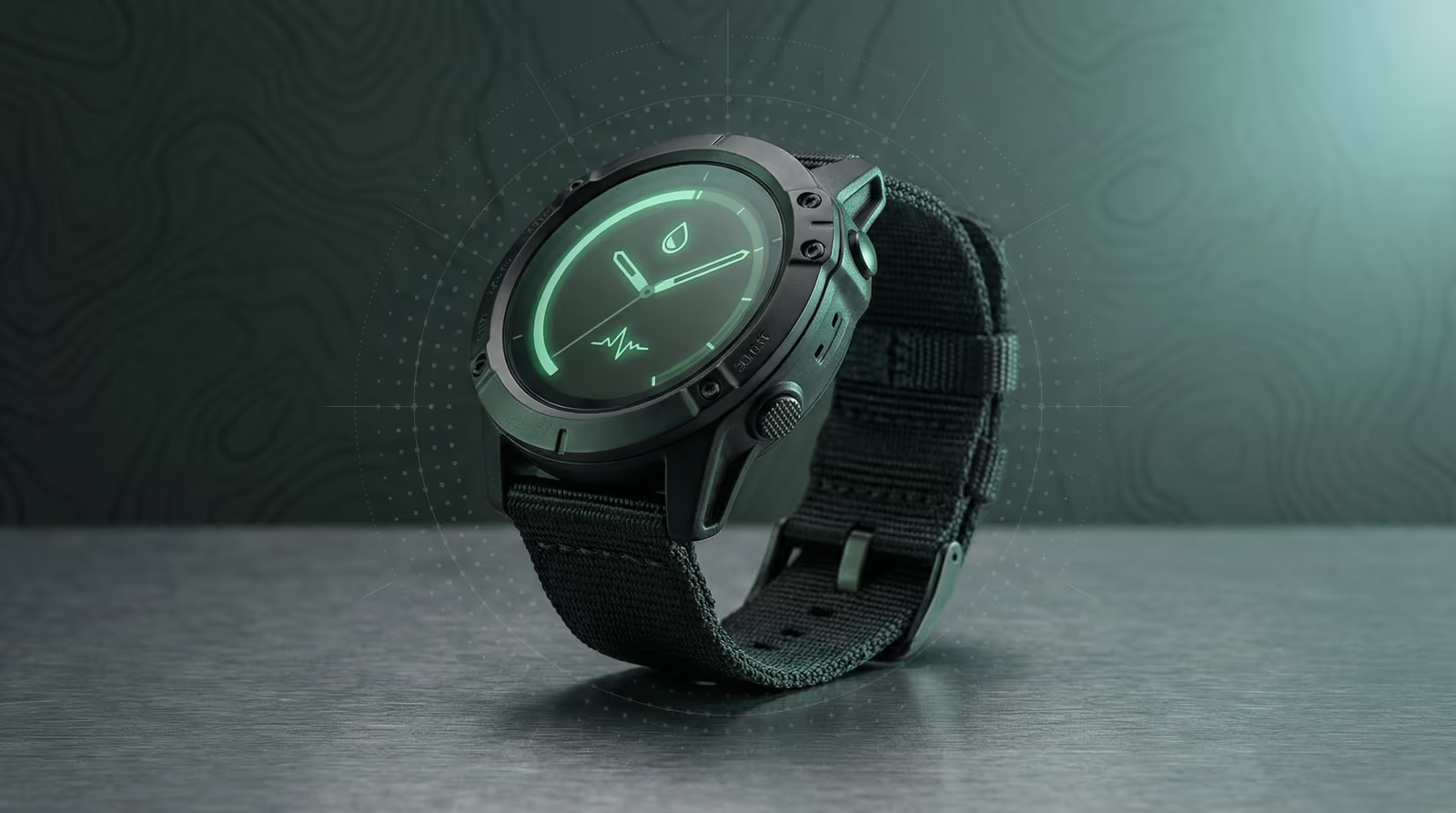
DASA Reviewed Submissions
Product Validation Roadmap
UK Defence Accelerator
Tech Stack
The problem
Soldiers in hot or arid environments often don't realize they're dangerously dehydrated until they're already impaired or in danger. Blood tests aren't an option in the field, and manual hydration schedules don't adapt to each soldier's real physiological state. A smartwatch that could silently measure hydration through the skin - with no needles, no interruptions - could prevent heat casualties before they happen.
The challenge
Soldiers operating in austere environments have no reliable way to monitor hydration status without stopping to self-assess - a dangerous lag between physiological need and corrective action. ArcX TacSense aimed to solve this with a ruggedised smartwatch that could non-invasively detect hydration status in real time using a microwave dielectric sensor at the wrist, alongside GPS position tracking and biometric monitoring. Securing DASA funding required proving the concept on three axes: that the tactical need was real and unmet (Desirability), that the microwave sensing approach was technically feasible at wrist-wearable scale (Feasibility), and that a viable commercialisation path existed through the defence procurement pipeline (Viability). All three reviews had to be grounded in published academic research and framed against DASA's innovation criteria - alongside a structured risk assessment and a credible EVT→DVT→PVT hardware validation roadmap.
Product Requirements Document
PRODUCT REQUIREMENTS DOCUMENT
ArcX TacSense - Military Tactical Smartwatch
Varun Cumbanungam · Product Manager · ArcX / TEV (2024)
Doc ID
ARCX-PRD-V1
Status
Submitted
Owner
Varun C.
Date
2024
Version
1.0
Problem Statement
Soldiers in austere environments lack real-time hydration monitoring. TacSense must detect dehydration via microwave sensing at the wrist, with GPS + biometrics, in a MIL-STD-810 ruggedised wearable.
Primary Users
Front-line Soldier
Passive hydration monitoring, GPS, biometrics
Field Medic
Remote physiological status of squad
MoD Procurement
Grant-funded innovation pathway
DASA Reviewer
Desirability, Feasibility, Viability evidence
Core Requirements
- REQ-001: Microwave sensing - ≥1 hydration read/min
- REQ-002: GPS ±5m accuracy, 30s polling interval
- REQ-003: Heart rate + skin temp ≥1Hz continuous logging
- REQ-004: Battery ≥72h continuous (-20°C to +55°C)
- REQ-005: AES-256 encryption on all RF transmissions
- MIL-STD-810: shock, vibration, waterproofing verified
Key Acceptance Criteria
- AC-1Hydration alert within 60s of threshold breach
- AC-2GPS accuracy verified ±5m in open field test
- AC-3Battery passes endurance at -20°C and +55°C
- AC-4MIL-STD-810 shock test - no functional failure
- AC-5RF data AES-256 encrypted - pen test verified
- AC-6DASA Desirability review accepted without major revision
DASA Validation Pathway
- EVTEngineering Validation - sensor + GPS baseline
- DVTDesign Validation - ruggedisation + form factor
- PVTProduct Validation - field trial + DASA review
Key Risks
- HIGH
Microwave sensor insufficient sensitivity at wrist
Phantom testing + academic protocol review
- HIGH
GPS unreliable indoors / in cover
Dead-reckoning offline fallback specified
- MED
Battery target not met in cold conditions
Thermal modelling + chemistry review
RESTRICTED · ArcX TacSense PRD · DASA Grant Documentation
PRD · Risk Assessment · EVT→DVT→PVT Roadmap · RPTM Requirements
Full PRD and supporting artefacts available upon request
Grant Proposal Structure & Product Roadmap
Ruggedized wearable device with non-invasive physiological sensing to detect hydration status. Integrated GPS for position tracking with field accuracy. Heart rate and temperature monitoring. All wireless transmissions encrypted. Engineered for extended operation (72+ hours) across temperature extremes and harsh field conditions. Meets military equipment durability specifications.
The grant proposal was structured in four layers. The Desirability Review mapped the tactical problem to ArcX TacSense's value proposition: real-time hydration and physiological status monitoring, reducing soldier casualty risk in hot/arid environments, replacing manual hydration scheduling with physiologically-triggered alerts. The Feasibility Review assessed the core technical challenge - integrating a microwave dielectric spectroscopy sensor into a wrist-worn package with sufficient sensitivity to detect tissue hydration changes - drawing on published research on microwave sensors using skin phantoms (reviewed: two peer-reviewed papers on non-invasive hydration measurement). The Viability Review addressed commercialisation: the defence procurement pathway, IP position relative to competing approaches (bioimpedance, sweat sensors), and the DASA programme structure. The product roadmap used a standard hardware validation pipeline: EVT (Engineering Validation Test) for core sensor/GPS functionality, DVT (Design Validation Test) for form-factor and environmental ruggedisation, and PVT (Product Validation Test) for field validation prior to DASA milestone review. A risk assessment matrix evaluated programme, technical, and regulatory risks with mitigation plans.
Results
Delivered the complete DASA grant submission package for ArcX Technology: three reviewed documents (Desirability, Feasibility, Viability), a wrist-wearable risk assessment matrix, a structured testing regime for the RPTM, and a Gantt-based project plan covering EVT through PVT milestones. The submission established the academic grounding for non-invasive microwave hydration sensing at the wrist, mapped the defence acquisition pathway, and provided a credible hardware validation roadmap - constituting the full programme justification required for DASA Phase 1 consideration.
Gallery & Demos
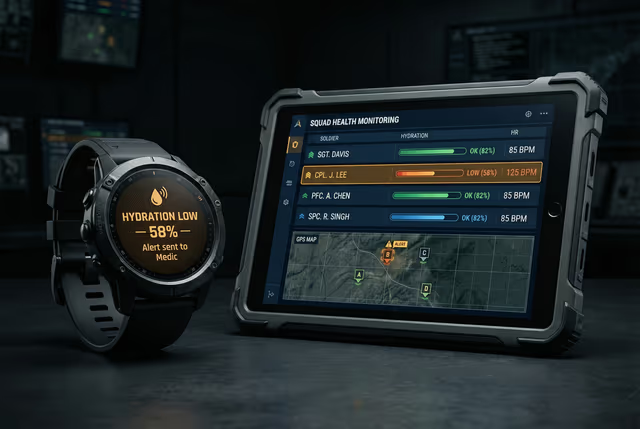
Squad Dashboard
Command center showing all soldiers' real-time location, hydration status, heart rate, and temperature - lets field medics monitor the whole team.
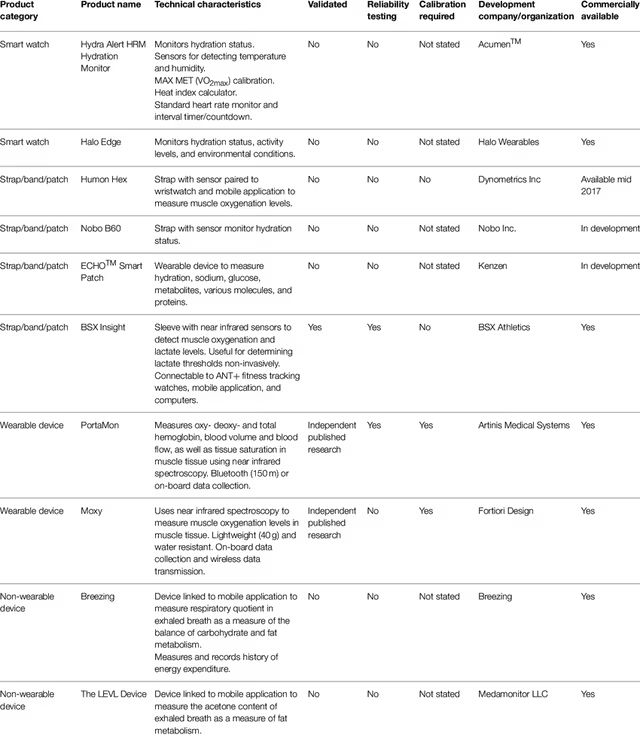
Hydration Sensor Reference
Technical diagram showing how the microwave sensor detects water content in skin tissue without invasive needles.
Click any image or video to expand · ← → keys navigate

More from Renovatio Systems
ArcX Ring - BLE Smart Ring iOS QA
Structured iOS test campaign for the ArcX Ring (BLE smart ring with joystick HID) prior to its commercial launch - covering ring hardware behaviour, iOS app compatibility across three devices, and multi-week battery endurance. 50+ test cases executed against firmware v0.9.4; identified 3 critical failures including a centre-button reliability defect and a call-rejection failure.
Swing Box - IoT Gym Equipment Security
Hardware product management for 'Swing Box' - a connected security enclosure for shared-use gym equipment (dumbbells, kettlebells). Defined the full product specification: load-cell weight detection, solenoid lock/unlock, GPS geofencing, 60-day battery target, and mobile app command flow. Delivered BOM, CAD enclosure review, system block diagram, and risk assessment matrix.
Interested in this work?
I can walk through the architecture and code during an interview.