
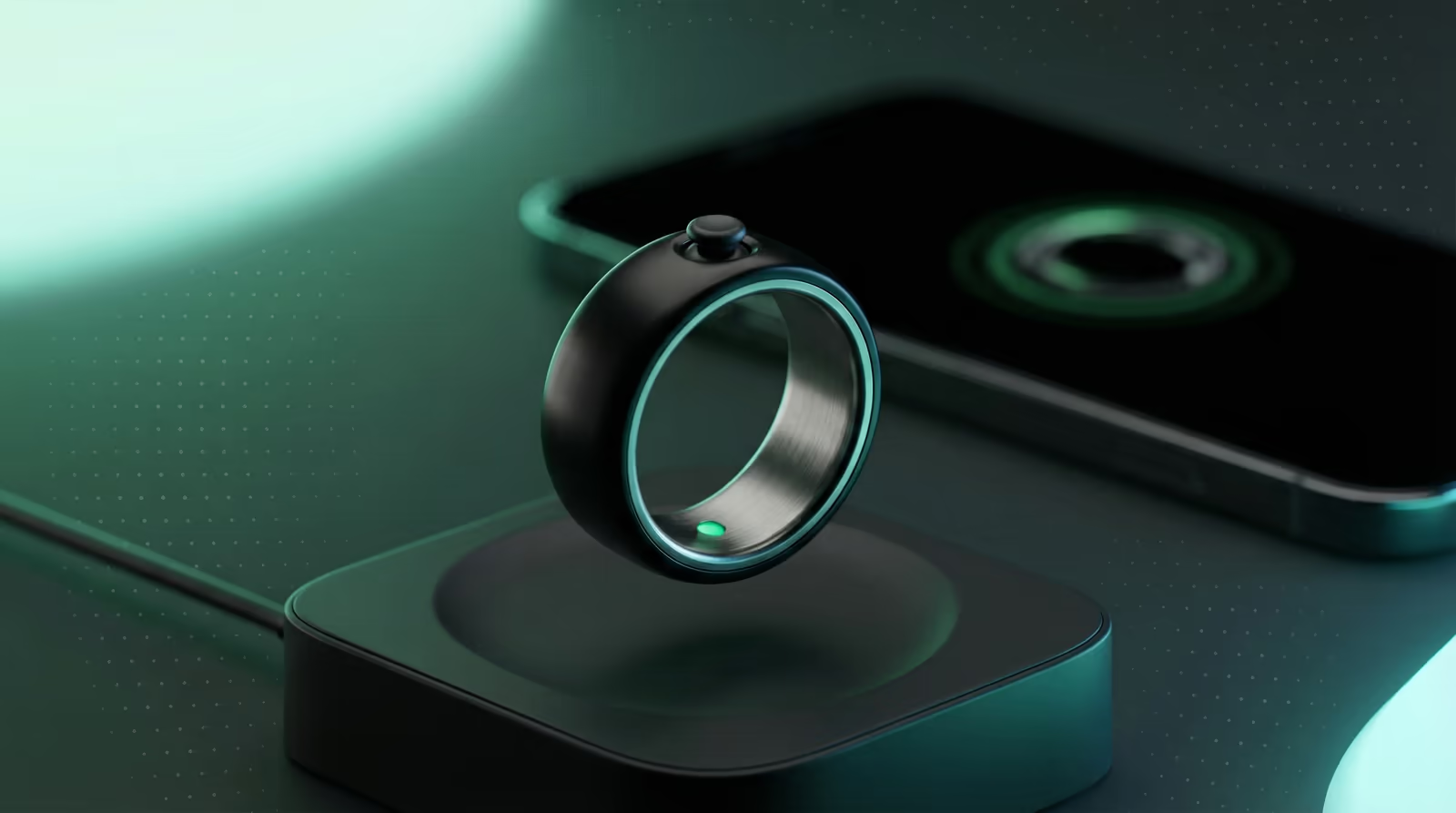
ArcX Ring - BLE Smart Ring iOS QA
50+ tests across ring hardware, the iOS app, and battery endurance, with 3 critical defects caught before launch.
Test Cases Executed
Defects Identified
Actual Battery Life (vs 10 h target)
Tech Stack
The problem
A smart ring that controls your music and calls needs to work reliably across different iPhones before it ships to customers. One undetected bug - a button that doesn't work, a pairing flow that breaks - shows up immediately in user reviews and can permanently damage a new brand's reputation.
The challenge
The ArcX Ring was approaching its first commercial iOS release - a BLE smart ring with a 5-axis joystick for media playback and call management, paired to an iOS companion app. Before launch, a structured cross-device test campaign was needed covering ring hardware behaviour (BLE pairing, firmware OTA via nRF Connect, joystick HID command mapping), iOS app compatibility across iPhone 8, iPhone 8 Plus, and iPad 7, and battery endurance under both indoor and outdoor usage conditions. The test suite had to be structured enough to gate the firmware release, produce a formal test record for the hardware team, and surface any regression between the current and previous firmware builds.
Product Requirements Document
TEST REPORT SUMMARY
ArcX Ring - BLE Smart Ring iOS QA
Varun Cumbanungam · QA Lead · ArcX / TEV · March 2021
Doc ID
ARCX-QA-V1
Status
Complete
Owner
Varun C.
Date
Mar 2021
Version
1.0
Test Scope
Pre-commercial iOS QA - ArcX Ring (BLE joystick smart ring). 50+ test cases covering hardware, iOS app compatibility on 3 devices, and multi-week battery endurance. Firmware v0.9.4 · Hardware v0.10.0.
Test Domains
Ring Hardware (20 cases)
BLE pair, OTA, joystick HID, LED indicators
iOS App (24 cases)
Install, startup, BT perms, 3-device compat
Battery Endurance (6 cases)
Charge time, drain, continuous, standby
Critical Defects Found
- RING-10: Centre button Play/Pause - inconsistent (Critical)
- RING-17: Call rejection double-press - did not work (Critical)
- IOS-14: Pairing request on app startup - not triggered (Critical)
- BAT-4: Continuous use 6h 30min vs 10h target (Fail)
Key Test Results
- RING-10Centre button Play/Pause - FAIL (Critical)
- RING-17Call rejection double-press - FAIL (Critical)
- IOS-14Pairing request on startup - N/A (Critical)
- BAT-4Continuous use (target 10h) - FAIL, 6h 30min
- RING-12Signal strength -43 dBm - PASS
- BAT-66-week standby endurance - BELOW TARGET
Battery Summary
- Charge0-100% in 81 min - Pass
- Idle1h indoor drain - minimal, Pass
- Cont.6h 30min - Fail (target 10h)
- Standby5-week - 53% by week 4, below target
Product Artefacts Delivered
- Excel test report - 50+ cases, pass/fail/NYA
- Critical defect log - RING-10, RING-17, IOS-14
- Battery drain chart - 5-week SOC measurements
- Release gate - hold pending 3 critical fixes
CONFIDENTIAL · ArcX Ring QA Report · Property of ArcX / TEV
Test Report · Critical Defect Log · Battery Chart · Release Gate
Full PRD and supporting artefacts available upon request
Test Structure & Coverage
Wearable ring communicates with mobile app via Bluetooth. Multi-axis input interface captures user commands for media and call control. Mobile app interprets signals and triggers system actions. Battery endurance tested under realistic usage patterns. Testing uncovered 3 critical hardware and software issues requiring design iteration before commercial release.
The test campaign was organised into three domains. Ring Hardware (20 cases): BLE discovery and pairing, automatic reconnection, firmware OTA update via nRF Connect app, joystick HID commands (play/pause, skip track, volume up/down, call answer/end/reject), charging LED indicators. iOS App (24 cases): installation, startup time, Bluetooth permission flow, resolution across three devices, ring selection, theme selection, firmware/hardware/software version display, battery status readout, crash resilience, and screen orientation. Battery (6 endurance cases): charge time from 0-100% (~70 min), indoor and outdoor 1-hour drain, continuous use endurance (~6.5 h), idle-connected endurance, and 5-week standby drain tracked at weekly intervals. All cases recorded against firmware v0.9.4, hardware v0.10.0, on iPhone 8, iPhone 8 Plus, and iPad 7.
Results
Identified 3 critical defects ahead of the commercial launch: centre-button play/pause unreliable across test sessions (RING-10), call rejection function non-functional (RING-17), and pairing request not triggering on app startup (IOS-14). Battery continuous-use life measured at 6.5 hours against a 10-hour target, with accelerated drain below 50% SOC documented across BAT-4 and BAT-5. Signal strength at -43 dBm was within the acceptable -40 to -60 dBm range. All pass/fail/NYA statuses were filed in a structured Excel test report for firmware and hardware team triage - providing the gate review evidence needed to hold the release until critical defects were resolved.
Gallery & Demos
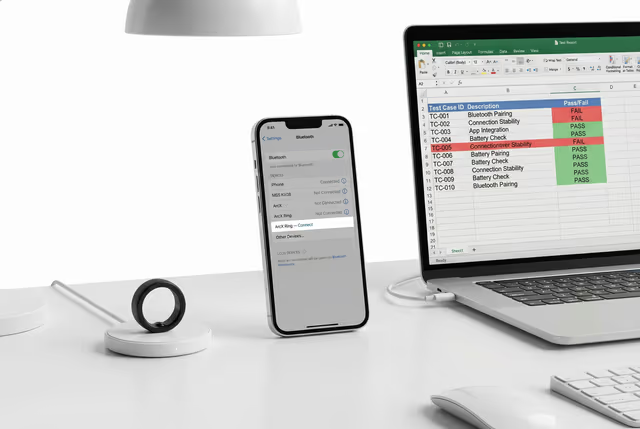
QA Test Setup
Test lab showing multiple iPhones and the ArcX Ring being tested together to ensure the ring works on all device models.
Click any image or video to expand · ← → keys navigate

More from Renovatio Systems
ArcX TacSense - Defence DASA Grant Proposal
Led the full DASA (UK Defence & Security Accelerator) innovation grant application for ArcX TacSense - a military tactical smartwatch combining GPS, biometrics, and non-invasive microwave-based hydration sensing. Authored all three reviewed submission documents (Desirability, Feasibility, Viability), the risk assessment matrix, the RPTM testing regime, and the EVT→DVT→PVT product roadmap.
Swing Box - IoT Gym Equipment Security
Hardware product management for 'Swing Box' - a connected security enclosure for shared-use gym equipment (dumbbells, kettlebells). Defined the full product specification: load-cell weight detection, solenoid lock/unlock, GPS geofencing, 60-day battery target, and mobile app command flow. Delivered BOM, CAD enclosure review, system block diagram, and risk assessment matrix.
Interested in this work?
I can walk through the architecture and code during an interview.