
Ummidvar - AI Job Application Agent
An India-first job application agent with explainable scoring, tailored applications, reply tracking, and sponsorship signals.

Tests Passing
Lines of Code
Modular Packages
Tech Stack
The problem
Applying to jobs properly - writing tailored cover letters, tracking applications, following up - takes hours per application. Most people either apply carelessly or burn out from the volume. There was no tool that handled the tedious parts intelligently while keeping the human in control and never putting words in their mouth they didn't actually say.
The challenge
Job searching at scale means applying to dozens of roles with individually tailored materials - a process that takes hours per application done properly. The hard problems: aggregating and deduplicating jobs across 7+ platforms without keyword noise; scoring each role against a resume using a meaningful composite algorithm rather than shallow keyword overlap; generating cover letters that sound like the user wrote them - not an LLM - while never fabricating experience (anti-hallucination via a Facts Graph); submitting through real ATS systems (Greenhouse, Lever, Ashby, Workday) using browser automation that can pause on CAPTCHAs and hand off to the user instead of breaking; tracking email replies to classify interviews, rejections, and ghosting; and layering in visa-sponsorship intelligence for international job seekers across UK, AU, NZ, CA, and EU registries. The system also had to be India-first in design (Naukri integration, INR salary handling) while supporting multi-profile, multi-preference search.
Architecture & System Design
Multi-board job discovery engine ranks opportunities by skills match, role level, location fit, and compensation. Fact-grounded generation prevents hallucinated experience claims - all content references verified resume data. Browser automation submits applications through major ATS systems. Email integration tracks application replies (offers, interviews, rejections). Visa sponsorship eligibility checker across 5 countries. Modular architecture with pluggable LLM backend.
11 modular Python packages orchestrated by a FastAPI REST API. The `core` package defines pure domain models (Job, BaseResume, FactsGraph, Application, MatchScore) with no I/O - a clean domain layer. `discovery` wraps python-jobspy for multi-board aggregation with deduplication. `scoring` implements a 100-pt composite: skills overlap (0-40, Jaccard), title/seniority (0-20), location fit (0-15), salary alignment (0-10), semantic similarity (0-15) - every score is explainable. `tailoring` uses deterministic Facts Graph extraction to build an anti-hallucination contract before calling any LLM, ensuring generated text only references verified experience. `humanizer` applies a style-preserving rewrite pass that strips AI tell-tale patterns. `adapters` provides Playwright-backed ATS submit flows for Greenhouse, Lever, Ashby, Workday, and LinkedIn, with a HITL blocker queue that snapshots state on CAPTCHA/MFA and resumes from checkpoint. `replies` ingests Gmail/IMAP and classifies responses (offer, interview, rejection, ghost). `sponsorship` bundles 5 live government registries. `referrals` ingests LinkedIn CSV exports, scores connection strength, and drafts intro messages. LLM backend is fully pluggable: TemplateLLM (zero-dep default), Ollama, OpenAI, Anthropic, or any compatible API - swapped via env var.
Results
Ummidvar is production-deployable via Docker Compose in a single command. The codebase spans 6,600+ lines across 11 packages with 286 passing tests (unit + integration) covering every major component - Facts Graph extraction, composite scoring, LLM adapters, ATS submission adapters, reply classifier, sponsorship registry loaders, and referral finder. The discovery layer aggregates and deduplicates from LinkedIn, Indeed, Glassdoor, ZipRecruiter, Google Jobs, Naukri, and direct career pages. The Playwright engine handles Greenhouse, Lever, Ashby, Workday, and LinkedIn ATS flows with HITL blocker queue for CAPTCHAs. The sponsorship layer cross-references 5 government registries (UK · AU · NZ · CA · EU) live, refreshed weekly via GitHub Actions. Apache-2.0 licensed for future hosted-tier expansion.
Gallery & Demos
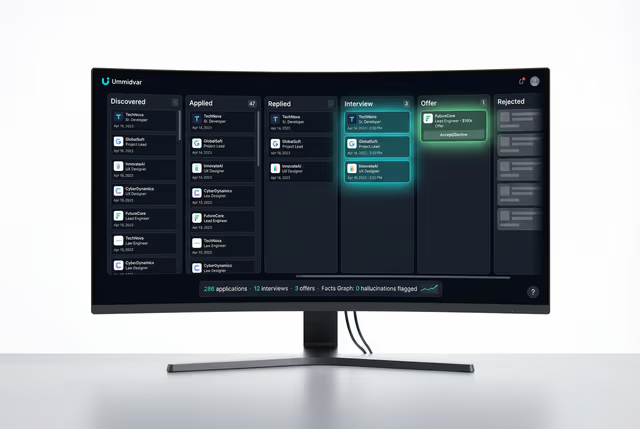
Application Tracker Dashboard
Kanban board showing job applications across stages: Discovered, Ranked, Tailored, Applied, Interview Scheduled, Offer Received, and Rejected.
Click any image or video to expand · ← → keys navigate

More from Personal Project
Ummidvar - Autonomous Job Agent
Product vision and feature scoping for Ummidvar - an autonomous, multi-profile job application agent. Defined the 11-package modular architecture from a product perspective, prioritised the anti-hallucination Facts Graph as a non-negotiable product constraint, and scoped visa-sponsorship intelligence for 5 international markets.
Sylars Work Manager - Agent Operations Workspace
A self-hosted workspace for assigning repository work to AI agents with exact-SHA project context, isolated task environments, progress steering, and explicit human approval gates.
Watchdog - Multi-cloud Observability Control Plane
A privacy-minimised observability and safe-operations control plane spanning AWS, Azure, GCP, container hosts, registry storage, incidents, and exact human-approved cleanup plans.
RenderBoard AI - Interior Design Rendering Platform
An AI interior-design workspace: upload a floor plan, confirm rooms and scale, place furniture, approve each room, then render path-traced and diffusion images into a presentation board. Runs on Azure with scale-to-zero GPU workers.
BidWave - Freelance Opportunity Engine
A self-hosted pipeline that scrapes four freelance platforms, de-duplicates listings, ranks fit with a TF-IDF prefilter and an LLM rerank, drafts proposals, and holds every application in a human approval queue.
LoadCell - Strength Machine Controller
A local-first Android app that drives personally owned Aroleap-compatible strength hardware over Bluetooth LE: set resistance, run custom plans, count reps from the machine's own telemetry, and keep every set even if the process dies.
Swadhika Studios - Editorial Interior Portfolio
A calm, editorial website for an interior-design and turnkey-delivery studio, built around full-bleed project photography, deliberate typography, and unhurried motion.
BidWave - Freelance Opportunity Intelligence
A self-hosted opportunity engine that aggregates freelance listings, ranks fit in two stages, drafts tailored proposals, and keeps application decisions under human control.
Atelier CRM - Studio Readiness & Delivery
A status-first CRM for boutique interior-design studios, connecting client approvals, procurement readiness, installation milestones, and project delivery in one operating view.
Interested in this work?
I can walk through the architecture and code during an interview.