VC.
ResearchHardware

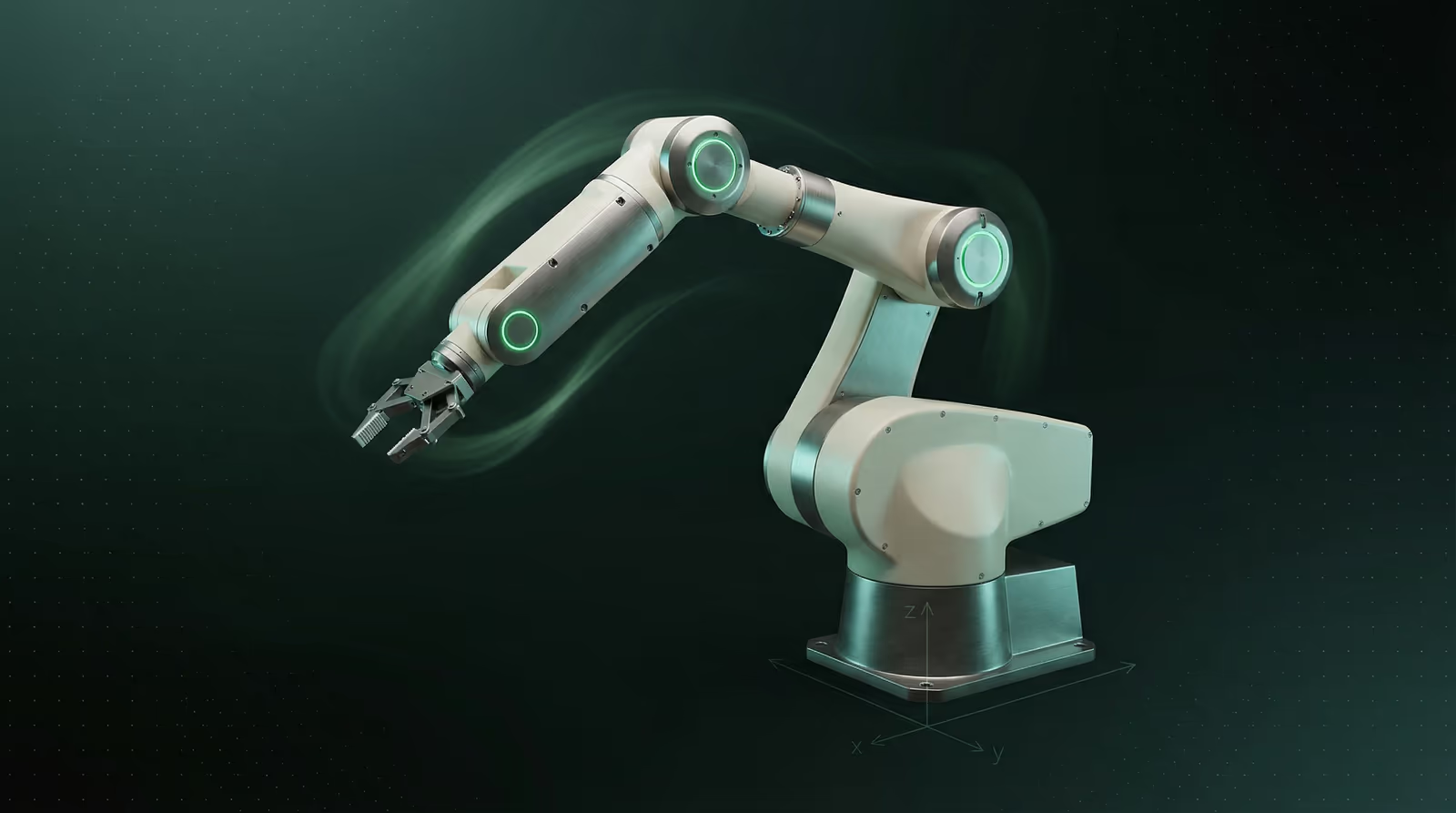
PUMA 6-DOF Robot Arm — Forward & Inverse Kinematics

From DH parameters to a live 3D robot simulator — FK, IK, and real-time joint control in MATLAB.

0-DOF

Joint Space

0-Solution

IK Enumeration

University of Utah

Research Lab

Tech Stack

MATLABDenavit-HartenbergRobotics Toolbox3D GraphicsInverse Kinematics

The Challenge

Building a correct inverse kinematics solver for a 6-joint robot arm means handling the inherent ambiguity of IK — a single Cartesian target can be reached by multiple joint configurations. The PUMA 762 IK has two sign choices (sqrt can be + or −) for θ1 and θ3, yielding up to 4 distinct solution branches. The solver must enumerate all branches, evaluate the full 6-joint angle set for each, and select the first solution where every joint stays within its physical travel limits.

Architecture & System Design

PUMA 6-DOF Robot Arm — Forward & Inverse Kinematics system architecture

Robot arm kinematics from Denavit-Hartenberg parameters: forward kinematics calculates end-effector pose from joint angles. Inverse kinematics solver evaluates multiple solution branches respecting physical joint limits. 3D simulator with collision detection.

Full system schematic available upon request

Forward kinematics uses the standard Denavit-Hartenberg chain: each joint contributes a 4×4 homogeneous transform, and the end-effector pose is the product of all six. Link parameters: a₂=650mm, a₃=0, d₃=190mm, d₄=600mm. The IK solver loops over all 4 sign-combination branches, computing θ1 and θ3 from the geometric decoupling solution, then back-solving θ2 from the joint-2/3 coupled equation, and finally resolving θ4–θ6 from the wrist orientation matrix. The 3D GUI (puma3d.m) renders the full arm model using capsule primitives, with interactive sliders for each joint, a motion trail renderer, and collision detection via capsule-capsule intersection tests.

Code Walkthrough

3-step walk-through of the production implementation — file paths and intent shown above each block.

  1. Step 1 of 3

    Forward kinematics — Denavit-Hartenberg product chain

    kinematics/PumaFK.m

    Forward kinematics maps six joint angles to the end-effector's 4×4 homogeneous pose matrix. The PUMA 762's DH parameters (a₂=650mm, d₃=190mm, d₄=600mm) are hard-coded as the authoritative source of truth for both the FK solver and the IK geometric decoupling — any error here propagates to every downstream calculation.

    matlab
    function T = PumaFK(theta)
    % PumaFK.mForward kinematics via Denavit-Hartenberg product chain.
    % Returns end-effector pose T (4x4 homogeneous) for given joint angles [rad].
    %
    % PUMA 762 DH parameters: [alpha_i-1, a_i-1, d_i, theta_i]
    % a2=650mm, a3=0, d3=190mm, d4=600mm
    
    dh = [     0,    0,   0,   theta(1);
          -pi/2,    0,   0,   theta(2);
               0,  650, 190,   theta(3);
          -pi/2,    0, 600,   theta(4);
           pi/2,    0,   0,   theta(5);
          -pi/2,    0,   0,   theta(6) ];
    
    T = eye(4);
    for i = 1:6
        al = dh(i,1);  a = dh(i,2);  d = dh(i,3);  q = dh(i,4);
        ca = cos(al); sa = sin(al); cq = cos(q); sq = sin(q);
        A  = [ cq, -sq*ca,  sq*sa, a*cq;
               sq,  cq*ca, -cq*sa, a*sq;
                0,     sa,     ca,    d;
                0,      0,      0,    1 ];
        T = T * A;
    end
    end
    Takeaway

    The DH table is the single source of truth for geometry — keep it as a named constant array so FK, IK, and Jacobian all read from the same definition rather than each hardcoding their own literals.

  2. Step 2 of 3

    Inverse kinematics — 4-solution enumeration

    kinematics/PumaIK.m

    A single Cartesian target admits up to 4 distinct joint configurations for a 6-DOF arm — two sign choices (√ can be + or −) for θ₁ and θ₃. The solver enumerates all four branches, computes the full 6-angle set for each, and returns the first solution that satisfies every joint travel limit. Skipping the enumeration would silently return configurations the physical arm cannot reach.

    matlab
    % PumaIK.m — 4-solution IK enumeration with joint-limit checking
    % DH params: a2=650, a3=0, d3=190, d4=600 [mm]
    
    for i = 1:4
        sign1 = (i <= 2) * 2 - 1;        % +1 for i=1,2 | -1 for i=3,4
        sign3 = (mod(i,2) == 1) * 2 - 1; % alternates +1, -1
    
        K       = (Px^2+Py^2+Pz^2 - a2^2-a3^2-d3^2-d4^2) / (2*a2);
        theta1  = atan2(Py,Px) - atan2(d3, sign1*sqrt(Px^2+Py^2-d3^2));
        theta3  = atan2(a3,d4)  - atan2(K,  sign3*sqrt(a3^2+d4^2-K^2));
    
        % Recover theta2 from the coupled joint-2/3 equation
        t23    = atan2((-a3-a2*c3)*Pz - (c1*Px+s1*Py)*(d4-a2*s3), ...
                        (a2*s3-d4)*Pz  + (a3+a2*c3)*(c1*Px+s1*Py));
        theta2 = t23 - theta3;
    
        % Wrist angles theta4-theta6 from orientation submatrix
        theta4 = atan2(-r13*s1 + r23*c1, -r13*c1*c23 - r23*s1*c23 + r33*s23);
        theta5 = atan2(s5, c5);
        theta6 = atan2(s6, c6);
    
        if all_within_limits(theta1,theta2,theta3,theta4,theta5,theta6)
            return;   % First valid solution wins
        end
    end
    Takeaway

    Enumerate all four branches before checking limits — choosing the first mathematically valid solution without checking limits returns configurations the physical arm cannot reach.

  3. Step 3 of 3

    Geometric Jacobian and singularity detection

    kinematics/PumaJacobian.m

    At singular configurations the Jacobian loses rank — the arm cannot move in certain Cartesian directions regardless of joint torque. The 3D GUI uses the Jacobian determinant as a real-time singularity alarm so the user knows when a slider-driven pose is approaching a degenerate configuration, preventing the IK solver from attempting a solution near a kinematic singularity.

    matlab
    function [J, is_singular] = PumaJacobian(theta)
    % PumaJacobian.mGeometric Jacobian (6x6) + singularity flag.
    
    SINGULARITY_TOL = 1e-4;
    
    % Build forward-transform chain
    T = cell(7,1);  T{1} = eye(4);
    for i = 1:6
        T{i+1} = T{i} * dh_transform(i, theta(i));
    end
    
    p_e = T{7}(1:3,4);   % End-effector position
    J   = zeros(6,6);
    
    for i = 1:6
        z_prev = T{i}(1:3,3);   % Rotation axis of joint i in world frame
        p_prev = T{i}(1:3,4);   % Origin of frame i-1
    
        % Linear velocity: z_{i-1} cross (p_e - p_{i-1})
        J(1:3,i) = cross(z_prev, p_e - p_prev);
        % Angular velocity: z_{i-1}
        J(4:6,i) = z_prev;
    end
    
    is_singular = abs(det(J)) < SINGULARITY_TOL;
    if is_singular
        warning('PumaJacobian: near-singular configuration (det=%.2e)', det(J));
    end
    end
    Takeaway

    The determinant threshold (1e-4) was chosen empirically — too tight and the GUI flashes warnings during normal motion; too loose and it misses wrist-flip singularities that crash the IK solver.

Results

The simulator correctly solves FK and IK for any reachable workspace point, selecting joint configurations that satisfy all six physical travel limits. The interactive GUI runs in real time, allowing the user to drag joint sliders or click a target position and watch the full arm animate to the solution. Collision detection via capsule-capsule intersection tests flags self-collisions during motion. The project formed the foundation for subsequent robot control research at the University of Utah.

University of Utah

More from University of Utah

Vision-Based Autonomous Quadrotor

Researcher

MS thesis project: a quadrotor capable of autonomously taking off, navigating, and perching on branch-like structures using only visual feedback — designed for autonomous crop monitoring in agricultural fields.

OpenCVPID ControlROS

Multi-Arm Coordination — 2-DOF QUANSER

Researcher

Dual-arm robotic manipulation system using 2-DOF QUANSER robots with a master-slave architecture — one arm controlling position, the other controlling force — to collaboratively manipulate objects with precision.

MATLAB/SimulinkQUARCImpedance Control

Adaptive Backstepping — Indoor Micro-Quadrotor

Researcher

Nonlinear controller design for an indoor micro-quadrotor with a suspended pendulum mass — a highly unstable configuration. Adaptive backstepping outperformed classical PID in robustness tests across multiple flight regimes.

MATLAB/SimulinkBackstepping ControlLyapunov Analysis

Sensor-Based SLAM Navigation — iRobot Create

Researcher

Autonomous mapping and navigation system on an iRobot Create platform using IR rangefinders and servo-mounted sensors for 360° SLAM — with RRT path planning to navigate complex maze environments.

MATLABiRobot CreateRRT Path Planning

Sampling-Based & Graph-Search Motion Planning

Researcher

MATLAB implementations of four canonical path-planning algorithms — Dijkstra, A*, PRM, and RRT — applied to a differential-drive robot navigating bitmap maps in configuration space, with real hardware execution on an iRobot Create.

MATLABRRTPRM

Monocular Depth Estimation for UAV Perch Landing

Researcher

C++/OpenCV vision system that estimates the 3D position and orientation of a landing perch from a single monocular camera — using image moments, covariance eigendecomposition for attitude, and focal-length triangulation for depth — enabling closed-loop visual servoing on a quadrotor.

C++OpenCVHSV Segmentation

RC Fixed-Wing Glider — Servo Actuation & Aerodynamics

Researcher

Fixed-wing RC glider designed and built from scratch — two servos providing roll and pitch authority via aileron and flap control surfaces, with a brushless DC motor and ESC delivering forward thrust. Flight-tested outdoors.

Servo ControlBrushless DC MotorESC

Interested in this work?

Full architecture walkthrough and code review available during interviews.