VC.
ResearchHardware

Multi-Arm Coordination — 2-DOF QUANSER

Master-slave force/position control for coordinated dual-arm object manipulation.

0-DOF

Per Arm

Master-Slave

Architecture

University of Utah

Research Lab

Tech Stack

MATLAB/SimulinkQUARCImpedance ControlForce/Position ControlC

The Challenge

Coordinating two independent robotic arms to manipulate a shared object requires real-time synchronisation of force and position feedback. One arm acting purely on position commands would cause the object to slip or deform if the other arm exerted unexpected forces. The system needed a control architecture where one arm "felt" the interaction forces and the other precisely tracked the desired trajectory.

Architecture & System Design

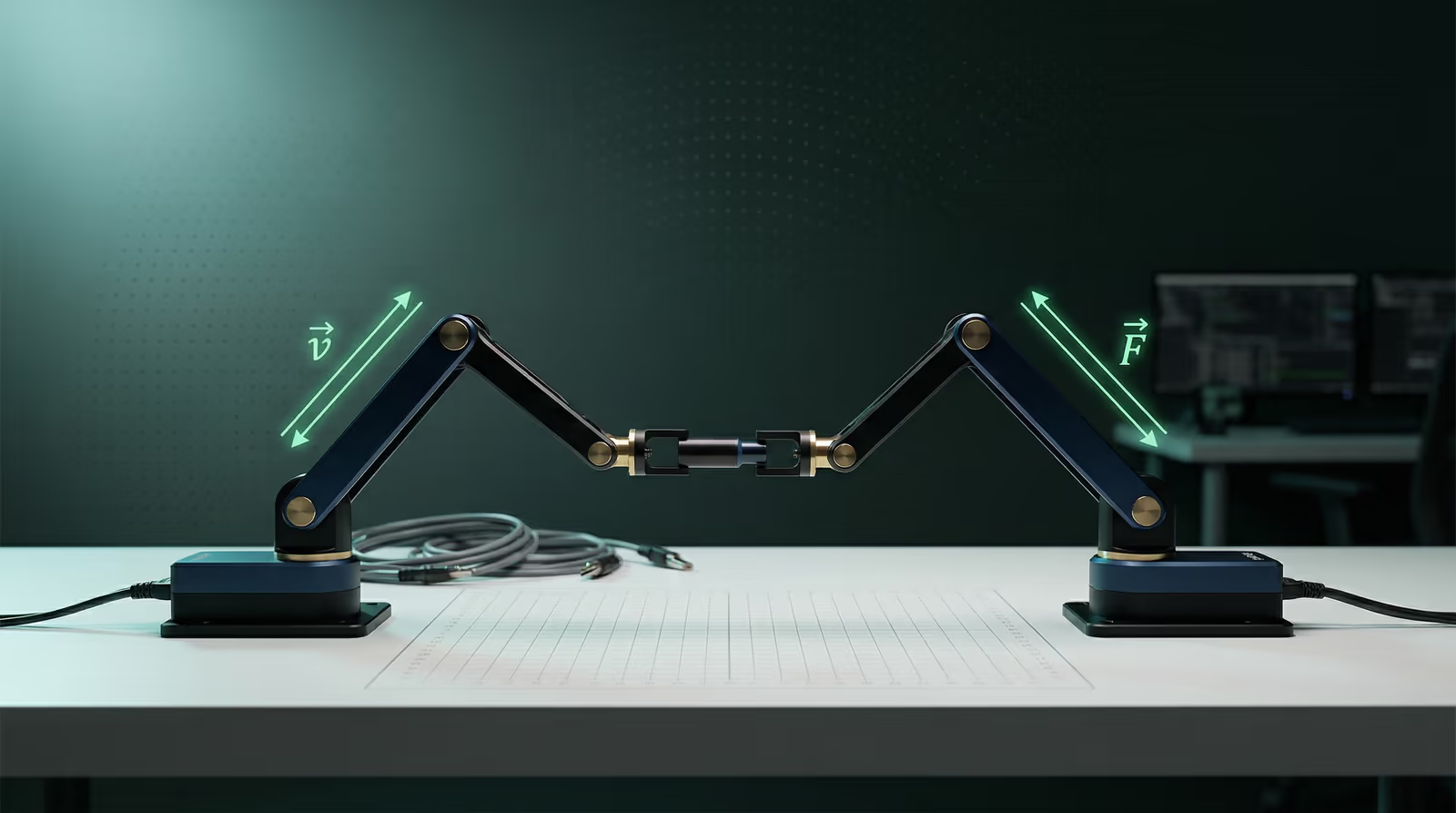
Multi-Arm Coordination — 2-DOF QUANSER system architecture

Two robot arms coordinate to manipulate shared object: master arm controls trajectory, slave arm adjusts force/compliance based on real-time feedback. Hybrid control law balances position accuracy with force regulation.

Full system schematic available upon request

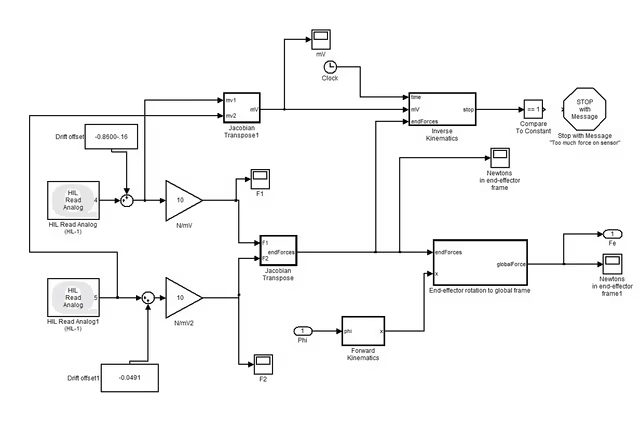
The QUANSER 2-DOF arms were interfaced through QUARC real-time control software running MATLAB/Simulink models. The master arm was configured in position control mode, providing the desired trajectory. The slave arm ran an impedance controller that regulated the contact force, adjusting its compliance based on real-time force/torque feedback. A hybrid force-position control law was derived analytically and validated in simulation before hardware deployment.

Code Walkthrough

3-step walk-through of the production implementation — file paths and intent shown above each block.

  1. Step 1 of 3

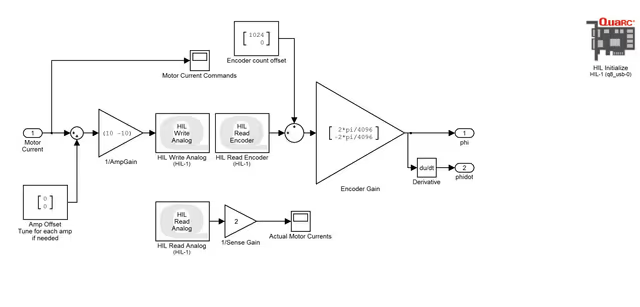
    Master arm pose acquisition via QUARC encoder interface

    control/master_pose.m

    The QUANSER SRV02 reports raw encoder counts; everything else in the control loop needs radians and rad/s. A persistent variable accumulates the previous angle so numeric differentiation gives velocity without a separate sensor. A low-pass filter smooths the derivative because encoder quantisation noise amplified by 1/dt produces spikes that saturate the impedance controller at 1 kHz.

    matlab
    function [q_master, dq_master] = read_master_pose(enc_ch1, enc_ch2, dt)
    % Read 2-DOF QUANSER SRV02 encoder channels and return joint angles + velocities.
    % Called at 1 kHz from the QUARC real-time Simulink loop.
    
    COUNTS_PER_REV  = 4096;          % 4x decoding enabled in QUARC config
    LOW_PASS_ALPHA  = 0.15;          % velocity filter bandwidth ~24 Hz
    
    % Encoder counts → radians, zero at horizontal reference pose
    theta1 = enc_ch1 * (2 * pi / COUNTS_PER_REV) - THETA1_OFFSET;
    theta2 = enc_ch2 * (2 * pi / COUNTS_PER_REV) - THETA2_OFFSET;
    q_master = [theta1; theta2];
    
    % Numeric differentiation + first-order low-pass (persistent state)
    persistent q_prev dq_prev;
    if isempty(q_prev)
        q_prev  = q_master;
        dq_prev = zeros(2,1);
    end
    
    dq_raw    = (q_master - q_prev) / dt;
    dq_master = LOW_PASS_ALPHA * dq_raw + (1 - LOW_PASS_ALPHA) * dq_prev;
    
    q_prev  = q_master;
    dq_prev = dq_master;
    end
    Takeaway

    Low-pass the velocity estimate, not the position — filtering position introduces phase lag that destabilises the 1 kHz control loop; filtering velocity only limits the spike without shifting the steady-state.

  2. Step 2 of 3

    Impedance controller — slave arm compliance law

    control/impedance_controller.m

    Pure position control on the slave arm would rigidly track the master trajectory and crush any object that pushes back. The impedance controller adds a virtual spring-damper between the desired and actual pose, so the arm yields under unexpected contact force. The Jacobian transpose maps the Cartesian force law back into joint torques the QUARC amplifier can execute.

    matlab
    function tau = impedance_controller(q, dq, F_ext, q_d, dq_d)
    % Impedance control law for 2-DOF QUANSER slave arm.
    % Regulates contact force while tracking master trajectory.
    
    Md = diag([1.2, 1.2]);    % Desired inertia  [kg]
    Bd = diag([8.0, 8.0]);    % Desired damping  [N·s/m]
    Kd = diag([40.0, 40.0]);  % Desired stiffness [N/m]
    
    % Position and velocity errors in joint space
    e   = q_d - q;
    de  = dq_d - dq;
    
    % Impedance law: virtual force from desired impedance + external reaction
    % Md·ddq + Bd·dq_err + Kd·q_err = F_ext + F_cmd
    F_cmd = Md * (Kd * e + Bd * de) + F_ext;
    
    % Map to joint torques via geometric Jacobian transpose
    J   = compute_jacobian(q);      % 2×2 for planar 2-DOF arm
    tau = J' * F_cmd;
    
    % Saturate to protect actuators3 Nm per joint)
    tau = min(max(tau, -TAU_MAX), TAU_MAX);
    end
    Takeaway

    Kd (stiffness) sets how tightly the slave tracks position; Bd (damping) prevents oscillation at contact. Tuning these two diagonals defines the feel of the interaction without changing the control law structure.

  3. Step 3 of 3

    Force feedback reflection to master arm

    control/force_feedback.m

    Without haptic feedback the operator driving the master arm has no sense of how hard the slave is pressing against the object — they can easily command destructive forces. Reflecting a scaled fraction of the contact force back as a resistive torque on the master arm closes the kinesthetic loop, giving the operator tactile sense of the interaction.

    matlab
    function apply_force_feedback(q_master, F_slave_contact)
    % Reflect slave contact force to master arm as haptic resistance.
    % Full reflection (gain=1) is too stiff for an operator; 0.4 is the
    % empirically stable limit for the QUANSER SRV02 actuators.
    
    REFLECTION_GAIN  = 0.4;
    MAX_FEEDBACK_NM  = 2.0;   % Operator safety saturation [N·m]
    
    J_master    = compute_jacobian(q_master);       % Jacobian at current master pose
    tau_reflect = REFLECTION_GAIN * (J_master' * F_slave_contact);
    
    % Saturate to protect operator and actuator
    tau_reflect = min(max(tau_reflect, -MAX_FEEDBACK_NM), MAX_FEEDBACK_NM);
    
    % Write to QUARC DACQUANSER: ±10 V → ±tau_max via motor constant K_t
    V_cmd = tau_reflect / (K_T * AMP_GAIN);
    write_analog_channels([V_cmd(1), V_cmd(2)]);
    end
    Takeaway

    The reflection gain is the only degree of freedom between 'operator feels nothing' and 'actuator slams back' — saturate before the DAC write, not after, so the voltage rail never clips the signal asymmetrically.

Results

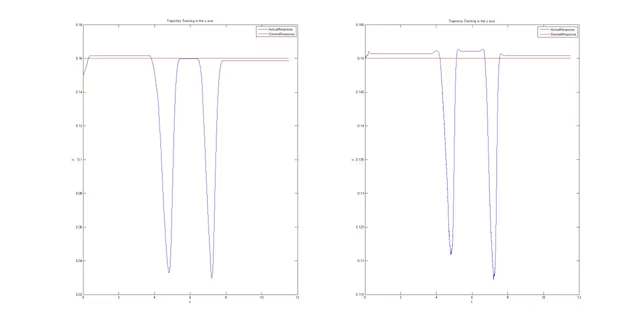
The master-slave system successfully demonstrated coordinated object manipulation with stable force regulation. The impedance controller maintained contact forces within ±0.2 N of the setpoint during dynamic manipulation tasks, enabling safe and compliant interaction with the shared object.

Gallery & Demos
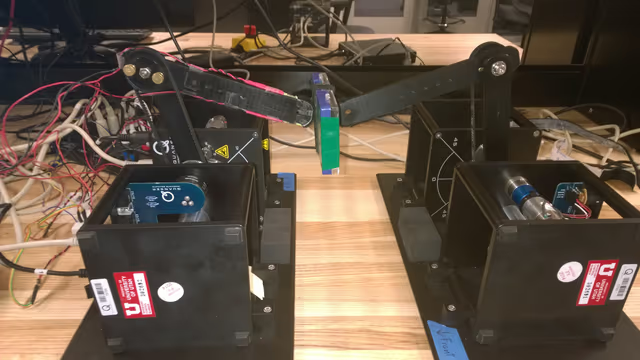
Multi-Arm Coordination — 2-DOF QUANSER screenshot

Click any image or video to expand · ← → keys navigate

University of Utah

More from University of Utah

Vision-Based Autonomous Quadrotor

Researcher

MS thesis project: a quadrotor capable of autonomously taking off, navigating, and perching on branch-like structures using only visual feedback — designed for autonomous crop monitoring in agricultural fields.

OpenCVPID ControlROS

Adaptive Backstepping — Indoor Micro-Quadrotor

Researcher

Nonlinear controller design for an indoor micro-quadrotor with a suspended pendulum mass — a highly unstable configuration. Adaptive backstepping outperformed classical PID in robustness tests across multiple flight regimes.

MATLAB/SimulinkBackstepping ControlLyapunov Analysis

Sensor-Based SLAM Navigation — iRobot Create

Researcher

Autonomous mapping and navigation system on an iRobot Create platform using IR rangefinders and servo-mounted sensors for 360° SLAM — with RRT path planning to navigate complex maze environments.

MATLABiRobot CreateRRT Path Planning

PUMA 6-DOF Robot Arm — Forward & Inverse Kinematics

Researcher

Full forward and inverse kinematics solver for a 6-DOF PUMA 762 robot arm, built from scratch using Denavit-Hartenberg parameters — with an interactive 3D MATLAB GUI featuring joint sliders, motion trail, and collision detection.

MATLABDenavit-HartenbergRobotics Toolbox

Sampling-Based & Graph-Search Motion Planning

Researcher

MATLAB implementations of four canonical path-planning algorithms — Dijkstra, A*, PRM, and RRT — applied to a differential-drive robot navigating bitmap maps in configuration space, with real hardware execution on an iRobot Create.

MATLABRRTPRM

Monocular Depth Estimation for UAV Perch Landing

Researcher

C++/OpenCV vision system that estimates the 3D position and orientation of a landing perch from a single monocular camera — using image moments, covariance eigendecomposition for attitude, and focal-length triangulation for depth — enabling closed-loop visual servoing on a quadrotor.

C++OpenCVHSV Segmentation

RC Fixed-Wing Glider — Servo Actuation & Aerodynamics

Researcher

Fixed-wing RC glider designed and built from scratch — two servos providing roll and pitch authority via aileron and flap control surfaces, with a brushless DC motor and ESC delivering forward thrust. Flight-tested outdoors.

Servo ControlBrushless DC MotorESC

Interested in this work?

Full architecture walkthrough and code review available during interviews.