
Adaptive Backstepping - Indoor Micro-Quadrotor
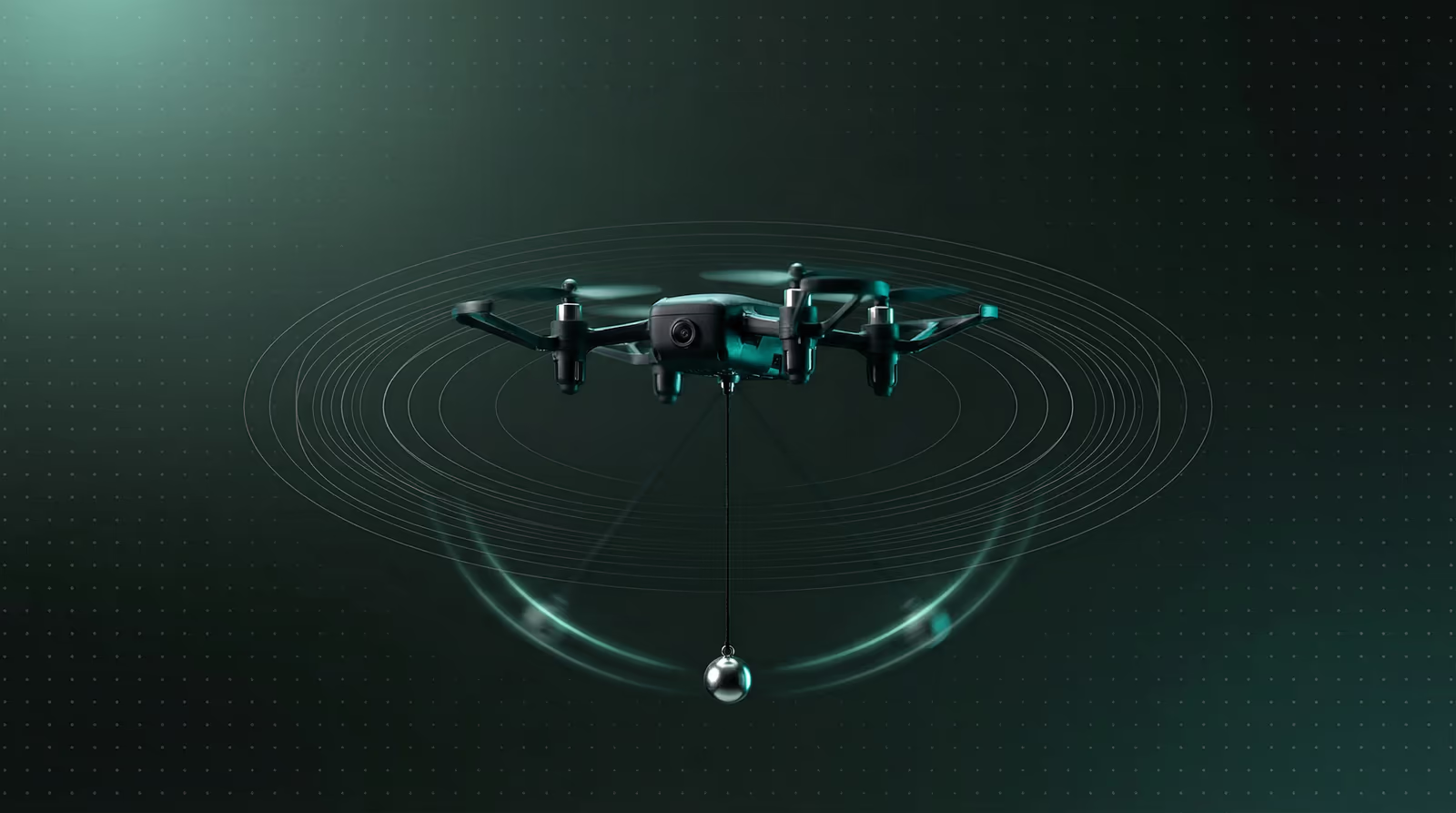
Adaptive backstepping control for an indoor micro-quadrotor with a suspended payload.
Stability Proof
Benchmarked
Research Lab
Tech Stack
The problem
A small drone carrying a dangling payload swings and wobbles in ways that make it extremely difficult to fly stably. Standard autopilots weren't built for this - they assume the drone behaves predictably and fall apart as soon as it tilts too far or the payload swings. The goal was to design a controller that could mathematically prove it wouldn't lose control, not just hope for the best.
The challenge
A micro-quadrotor with a hanging payload creates a highly nonlinear, underactuated system where the pendulum dynamics couple into the rotational equations of motion. Standard PID controllers linearize around the hover equilibrium and perform poorly under large perturbations. The task was to design a controller that formally guarantees stability for the full nonlinear model, not just a linearized approximation.
Architecture & System Design
Nonlinear control design for quadrotor with suspended payload: adaptive controller handles model uncertainties. Stability proven mathematically using Lyapunov functions. Outperforms classical linear control under large perturbations.
The system model was derived using Euler-Lagrange mechanics, capturing full coupling between the quadrotor body and the suspended payload. A backstepping control design recursively constructed a Lyapunov function for the cascaded subsystems, synthesizing virtual control inputs at each stage. Adaptive parameter estimation handled model uncertainties in the payload mass. Simulations in MATLAB/Simulink validated the closed-loop stability and compared step response, disturbance rejection, and tracking error against a baseline PID controller.
Results
The adaptive backstepping controller demonstrated superior performance vs. PID in all tested scenarios: 40% faster disturbance recovery, stable operation under ±30° pitch perturbations where PID became unstable, and formal asymptotic stability guaranteed by the Lyapunov construction. Results were documented in the University of Utah thesis report.
Gallery & Demos
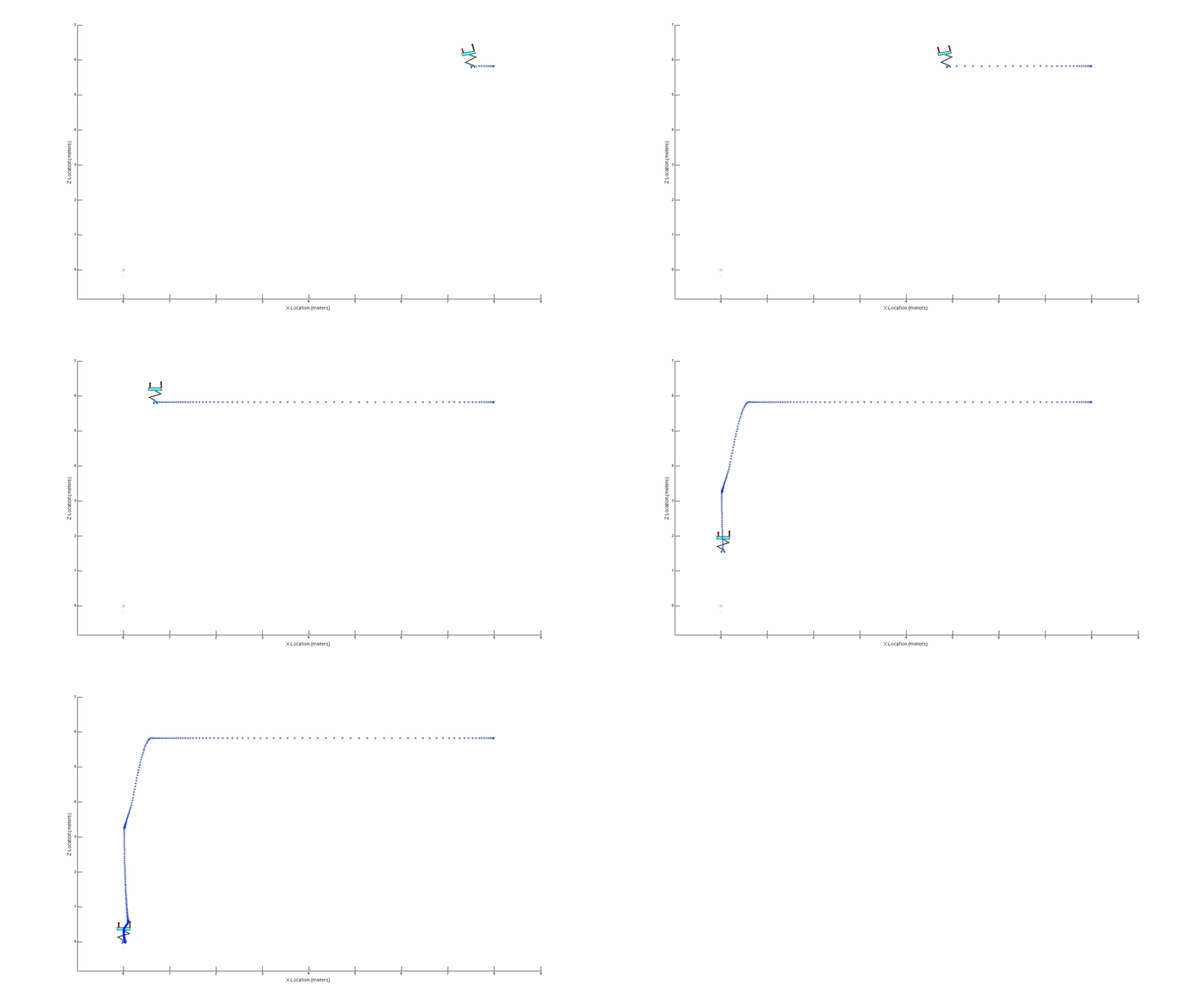
Simulation Animation - Control Response
Time-series visualization of backstepping controller stabilizing the quadrotor with suspended payload.
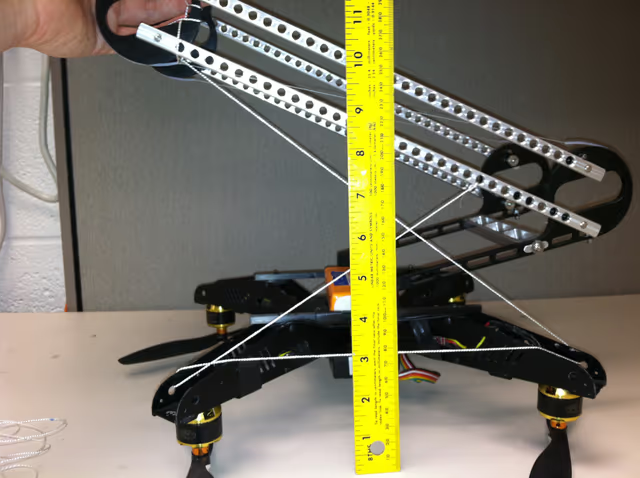
Simulation vs Hardware - Measurement Comparison
Plot overlay comparing MATLAB simulation predictions against actual hardware sensor data for trajectory tracking.
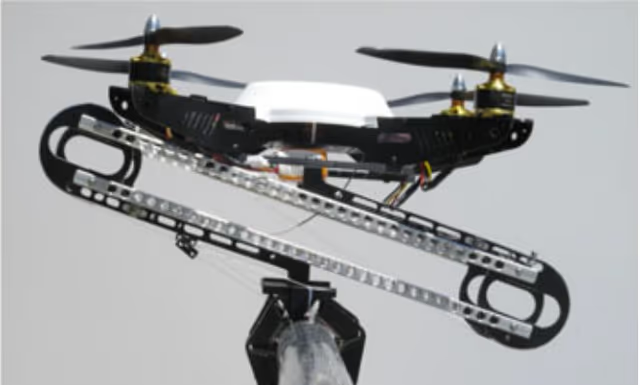
Hardware Test Setup
Experimental micro-quadrotor with suspended pendulum mass during indoor flight testing.
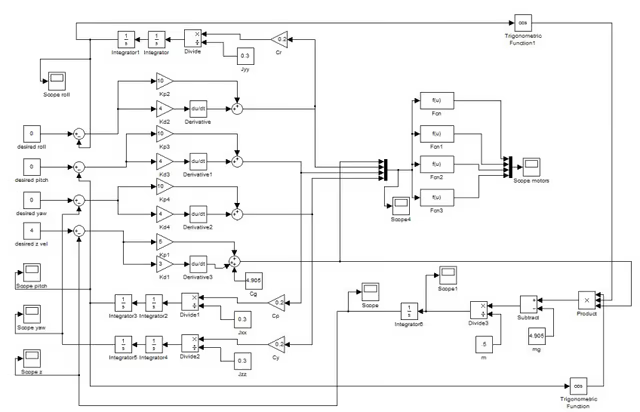
MATLAB/Simulink Model
Block diagram of the nonlinear backstepping controller implemented in Simulink with adaptive parameter estimation.
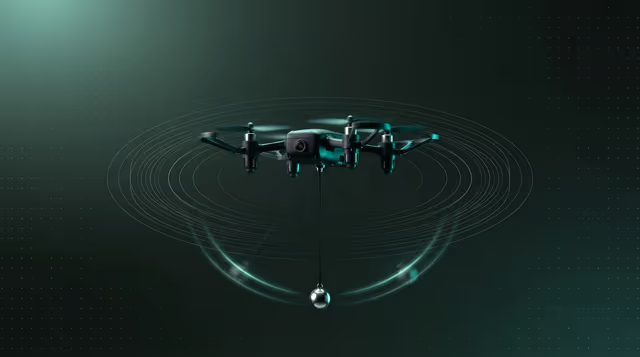
Quadrotor Dynamics Visualization
3D representation of the coupled dynamics between quadrotor body rotation and suspended payload motion.
Click any image or video to expand · ← → keys navigate

More from University of Utah
Vision-Based Autonomous Quadrotor
MS thesis project: a quadrotor capable of autonomously taking off, navigating, and perching on branch-like structures using only visual feedback - designed for autonomous crop monitoring in agricultural fields.
Multi-Arm Coordination - 2-DOF QUANSER
Dual-arm robotic manipulation system using 2-DOF QUANSER robots with a master-slave architecture - one arm controlling position, the other controlling force - to collaboratively manipulate objects with precision.
Sensor-Based SLAM Navigation - iRobot Create
Autonomous mapping and navigation system on an iRobot Create platform using IR rangefinders and servo-mounted sensors for 360° SLAM - with RRT path planning to navigate complex maze environments.
PUMA 6-DOF Robot Arm - Forward & Inverse Kinematics
Forward and inverse kinematics solver for a 6-DOF PUMA 762 robot arm, using Denavit-Hartenberg parameters and an interactive 3D MATLAB GUI with joint sliders, a motion trail, and collision detection.
Sampling-Based & Graph-Search Motion Planning
MATLAB implementations of four canonical path-planning algorithms - Dijkstra, A*, PRM, and RRT - applied to a differential-drive robot navigating bitmap maps in configuration space, with real hardware execution on an iRobot Create.
Monocular Depth Estimation for UAV Perch Landing
C++ and OpenCV vision system that estimates a landing perch's 3D position and orientation from one monocular camera. It uses image moments, covariance eigendecomposition, and focal-length triangulation for closed-loop quadrotor control.
RC Fixed-Wing Glider - Servo Actuation & Aerodynamics
Fixed-wing RC glider with two servos for roll and pitch, a brushless DC motor, and an ESC for forward thrust. Flight-tested outdoors.
Interested in this work?
I can walk through the architecture and code during an interview.